By my count, Laura Ingalls Wilder used the expression “40 below”, referring to temperatures, four times through her Little House book series: twice in Farmer Boy, once in The Long Winter, and once in These Happy Golden Years. (This was an extremely quick count, so if I am wrong, let me know in the comments and I’ll correct the post.)
Reading the entire series, it would be easy to come to the conclusion that temperatures around 40 below zero were fairly common in Laura’s childhood, especially in her DeSmet days. In a way, that conclusion wouldn’t be wrong. In Huron, South Dakota, since records began in July 1881, all of the years in the top 5 of most frequent temperatures of -30 °F or colder happened in the 1880s, and almost all of the top 10 were before 1950. Similar trends exist at other cold-weather sites like Bismarck, Minneapolis/St. Paul, and Fargo, or in other words, basically everywhere across the Northern Plains to Great Lakes. It just is harder to get that cold as our climate changes. But that doesn’t mean it’ll never get cold in the winter.
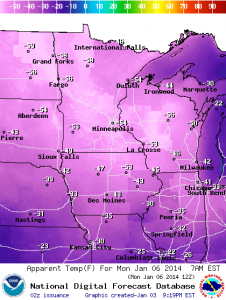
National Weather Service wind chill forecast for 6:00 AM CST on Monday, January 6. Forecast made on Friday afternoon, January 3.
With the Arctic outbreak coming this weekend into early next week (January 5-7), temperatures may approach readings that have not been seen in a decade or two in some locations. A few sites might even set a record or two, although record cold temperatures are less likely. The big story is with the wind chills, which are forecast to reach readings as cold as -50 to -60 °F in parts of the Dakotas, Minnesota, Wisconsin, and Iowa. We don’t have nicely collected, easily accessible wind chill records, like we do with temperatures and precipitation, to help us understand how frequently wind chills this cold happen. But most of us who work in weather know that it has been at least several years, and maybe a couple of decades, since we felt wind chills this cold.
A colleague in weather and climate asked me the ever-present question: WWLIWD? (For those who don’t speak the lingo, this translates to “What would Laura Ingalls Wilder do?”)
Here is my top 5 “WWLIWD to Handle the Cold” list:
1. Bring the woodpile into the house. Or, for those of us with modern heating equipment, make sure the heater is in good working order. Also, check the batteries on your carbon monoxide detectors and fuel up your car.
2. Make sure the pets have a cozy bed, and bring in the livestock to shelter with plenty of hay.
3. Gather up provisions so that you don’t have to go out in the cold to forage. Start a kettle of beans soaking now so that you have bubbling, warm bean soup during the heart of the cold snap.
4. Share a blanket or sweater or coat or fur cape or mittens with the less fortunate. Been holding onto a pile of clothes or bedding to donate to your local shelter? Now is a great time to take those goods to those who are most in need. Check on neighbors, friends, or family members who might struggle to keep their homes heated.
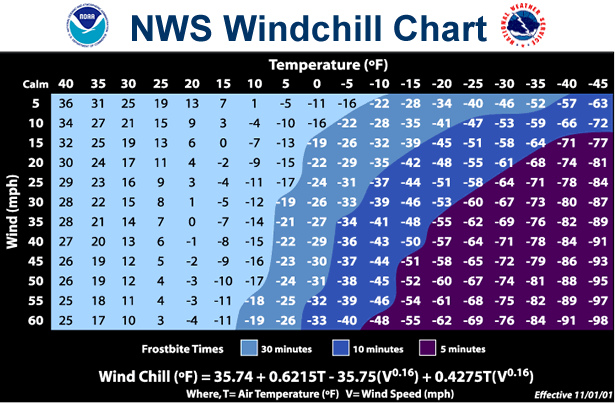
5. If you must go outside — for example, to spend a weekend away from your host and his crazy knife-wielding wife — be sure to dress in lots of layers and cover all of your exposed skin. Frostbite can begin in 10 minutes with wind chills around -35 to -40 °F, and as quickly as 5 minutes with those extreme -50 to -60 °F readings.
Seriously, don’t take a risk by going out in the cold for a prolonged length of time unless you absolutely must, especially when it’s windy. Learn from Laura’s mistake.
All of that said, Laura might think we’re all being a little wimpy. In These Happy Golden Years, she also used the expressions “only 15 below” and “only 20 below” while she was out riding cutters and otherwise enjoying the outdoors. And in Farmer Boy, Almanzo went sledding on that “forty below” day. The last lesson we can perhaps learn from Laura: don’t be afraid of the cold! Throw your hands back, inhale deeply, and feel the rush into your lungs! (Then get back inside by the fire.)
7 Responses to “40 Below”: WWLIWD?